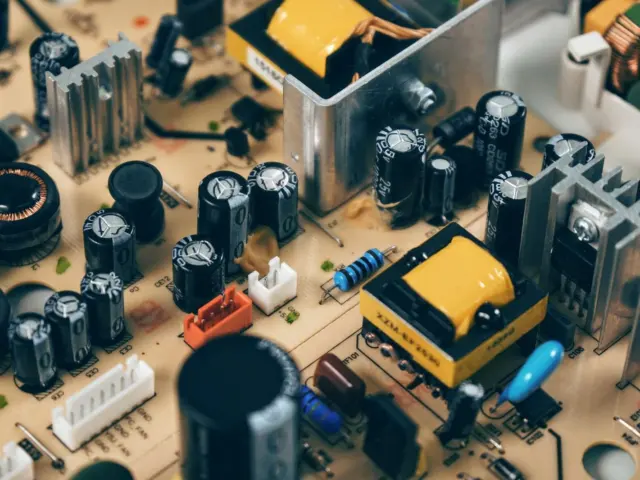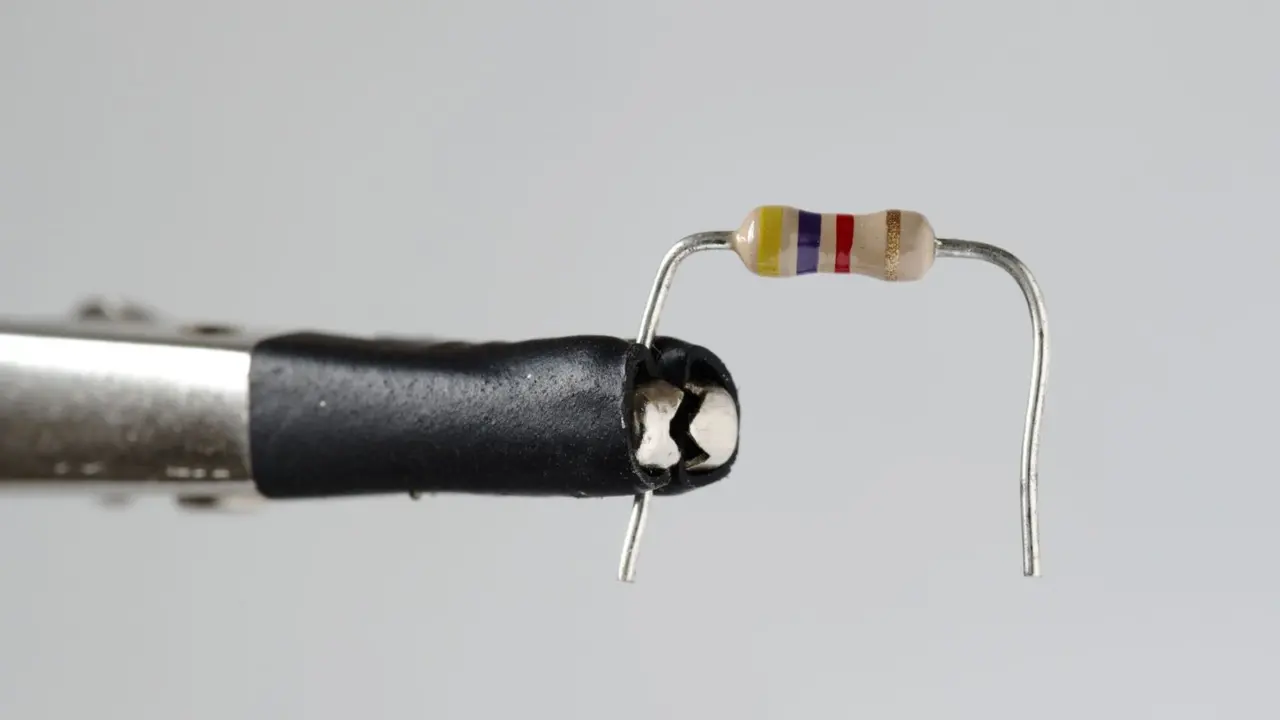
Wondering what is a resistor and why every circuit seems to have one? It is a two-terminal part that resists the flow of electric current, so you can control how much current and voltage reach other components.
This page is part of a wider look at electronic components, written for beginners.
| Item | Value |
|---|---|
| Terminals on a resistor | Two terminals |
| Most common power ratings | 0.25 W or 0.5 W |
| Carbon film resistance range | 1 ohm to 10 million ohms |
| E12 series | 12 values per decade, ±10% tolerance |
| E24 series | 24 values per decade, ±5% tolerance |
These figures come from technologyuk.net and Electronics Notes. Figures can change, so check the source before you rely on them.
What a resistor does in a circuit
The purpose of a resistor is simply to resist the flow of electrical current, as technologyuk.net puts it. It has two terminals and may be connected either way round, so there is no right or wrong orientation.
Most resistors have a fixed value and follow Ohm’s law. The current through the resistor varies in direct proportion to the voltage across it, according to the same technologyuk.net overview.
Resistors turn up in virtually all electrical devices and electronic circuits. Their values range from a fraction of an ohm up to several million ohms.

Common types of resistor
Resistors are made from many materials, and the construction decides how accurate, cheap or powerful a part is. The main families described by technologyuk.net are:
- Carbon composition: a solid core of powdered carbon and an insulating material. This type was widely used during the 1960s, but its tolerances were broad, so other types have largely replaced it.
- Carbon film: a carbon film on a ceramic rod with a spiral cut into it. Values run from 1 ohm to 10 million ohms, with tolerances of 10% or 5%.
- Wire-wound: thin metal wire wound around a non-conducting core. These generally carry more current than other types.
- Metal film: made with a similar film technique and able to reach very small tolerances.
A wire-wound resistor with an adjustable slider is a variable resistor, because you can change its resistance value. Metal film types are the ones in common use today, according to Electronics Notes.
How do you read a resistor’s value?
Most common resistors carry painted colour bands. The first two bands give a two-digit number, the third band gives the power of ten to multiply by, and a fourth band, if present, gives the tolerance (technologyuk.net).
Here is the worked example from that source, step by step:
- The first band is orange, so the first digit is 3.
- The second band is black, so the second digit is 0.
- The third band is red, so you multiply the number obtained (30) by 100. That gives a nominal value of 3,000 Ω, or 3 kΩ.
- The fourth band is gold, a tolerance of 5%. The real value can be anywhere from 2.85 kΩ up to 3.15 kΩ.
Gold means ±5% and silver means ±10%, while a missing fourth band normally means 20%. For every colour and the special cases, see the full resistor color code guide.
Values are also printed in text form. The BS 1852 style writes 4.7 kΩ as 4K7, which avoids a decimal point that could be misread when the print is very small, as LISA TTE Training explains.
Power rating: how much heat a resistor can take
As current flows, some electrical energy becomes heat. The power rating shows how much power, in the form of heat, a resistor can safely dissipate (technologyuk.net).
Power in watts is the product of voltage and current, written P = VI. A larger resistor surface area generally means it can shed more heat.
The resistors most commonly used in electronics are rated at 0.25 W or 0.5 W. Higher ratings are generally needed only when the resistor value is low (less than 300 Ω) or the applied voltage is high (greater than 15 V).
Standard values and tolerance
Resistors are not made in every possible value. Each one is quoted as a value plus or minus a percentage, and a 100 kΩ part with ±10% tolerance might be anywhere between 90 kΩ and 110 kΩ, according to LISA TTE Training.
Because of that spread, makers use E-series preferred values. Electronics Notes explains that the values are spaced so the tolerance band of one value does not overlap the next.
| Series | Tolerance | Values per decade |
|---|---|---|
| E6 | 20% | 6 |
| E12 | 10% | 12 |
| E24 | 5% (normally also available at 2%) | 24 |
| E48 | 2% | 48 |
| E96 | 1% | 96 |
A decade is a tenfold span of values, such as 10 Ω to 100 Ω, per LISA TTE Training. Tighter tolerance needs more values in each decade.
The series differ in how widely you will find them. The smallest, E3, has just three values: 1, 2.2 and 4.7, but it is seldom used as such because its tolerance is too wide for most applications (Electronics Notes).
In practice, the other series split like this:
- E6 and E12: available in virtually all types of resistor, according to Electronics Notes.
- E24: a much closer tolerance series, so it is only available in the higher tolerance types (Electronics Notes).
- E48: in common use, with better coverage of the decade than E24. It is also used instead of E96 where cost matters more than specific accuracy, per LISA TTE Training.
- E192: a tolerance of less than 1%, used only where great accuracy is important (LISA TTE Training).
Each series repeats in every decade by scaling. A preferred value of 47 can stand for 0.47 Ω, 4.7 Ω, 47 Ω, 470 Ω, 4.7 kΩ, 47 kΩ, 470 kΩ or 4.7 MΩ, as LISA TTE Training shows.
What if your design needs exactly 100 kΩ? LISA TTE Training calls that an unusual situation. You can select an exact-value part from within the range or, more likely, use a resistor with a closer tolerance.
Keeping to common values also helps manufacturers. Costs can be reduced because the number of component types on a printed circuit board can be reduced, and the same series are used for capacitors, Zener diodes and inductors (Electronics Notes).
Standard values also make sourcing easier, because parts from a variety of manufacturers can be chosen and cost is much lower (Electronics Notes). If you want to compare a resistor with a switching part, read about what is a relay.
Frequently asked questions
Does a resistor have a positive and negative side?
Show answer
No. A resistor has two terminals and may be connected either way round within a circuit, according to technologyuk.net.
What unit is resistance measured in?
Show answer
Resistance is quoted in ohms (Ω). High values commonly use kilohms or megohms, as LISA TTE Training notes.
What does a resistor do to current?
Show answer
It resists the flow of current. In a typical fixed resistor, current changes in direct proportion to the voltage across it.
Why do resistor values look oddly spaced?
Show answer
They come from E-series preferred values. The spacing is set by tolerance so that one value’s tolerance band meets the next without overlapping.
What happens if a resistor’s power rating is too low?
Show answer
The resistor must shed heat as fast as it makes it. If the heat cannot be lost to the surroundings at the same rate, it can overheat and suffer damage, as technologyuk.net describes.