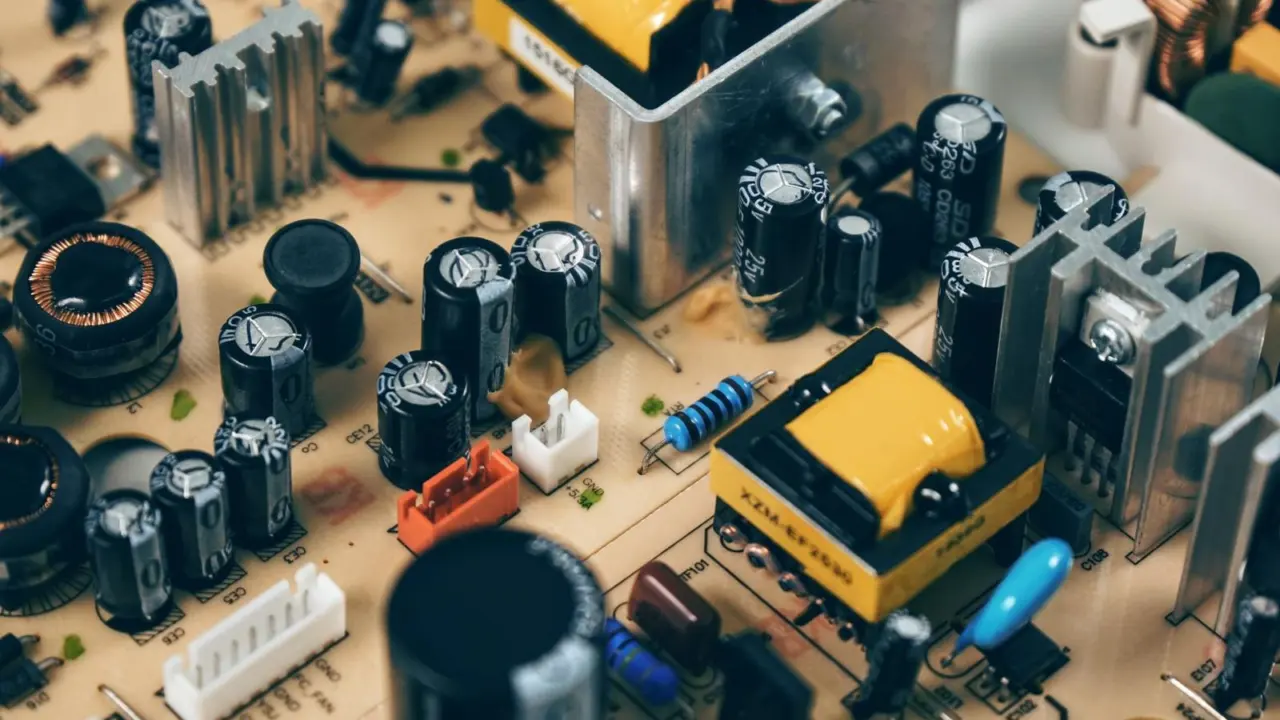
Staring at a bag of tiny parts and unsure where to start? Electronic components split into passive and active groups, and resistors, capacitors and inductors are the passive trio to learn first.
| Item | Value |
|---|---|
| Passive component types in basic circuits | Three: resistors, inductors and capacitors |
| Resistance is measured in | Ohms |
| Capacitance is measured in | Farads |
| Inductance is measured in | Henries |
| Small resistor rating and size | 1/8 watt, 2 mm by 1.5 mm |
| Battery charger example | 230 volts from the mains to approximately 12 volts |
These figures come from EEPower’s technical article on passive components and the IEEE Technology Navigator page on passive circuits. Figures can change, so check the source before you rely on them.
What are electronic components?
Electronic components are the individual parts a circuit is built from. Each part does a small job, such as limiting current, storing energy, switching a load or boosting a signal. A circuit links them together so those small jobs add up to something useful, like a radio, a charger or a lamp dimmer.
The most helpful way to sort the parts is into passive and active. According to EEPower’s December 2023 technical article, three types of passive components are used in electrical circuits: resistors, inductors and capacitors. The same article names diodes, transistors and thermionic valves as examples of active components, which have a non-linear reaction to voltage and current.
The IEEE Technology Navigator gives a tidy definition of the passive side. Passive circuits are networks made entirely of parts that do not supply energy from an external source. They can store, release and dissipate energy, but they cannot amplify it, so a passive circuit’s output power never exceeds its input power.
Wording differs between sources, and that can confuse a beginner. EEPower says passive means the component’s behavior changes little with voltage or current fluctuations. A Patsnap Eureka explainer puts it another way: active parts such as transistors and diodes need an external power source to function, while passive parts do not. Both descriptions point to the same practical split.
Here is a quick sorting guide you can keep beside your workbench:
- Passive: resistors, capacitors and inductors, plus close relatives such as potentiometers, transformers and relay coils.
- Active: diodes, transistors and thermionic valves.
- Active circuits: networks that include transistors, operational amplifiers or other devices capable of providing gain, as the IEEE page describes.
The rest of this guide walks through each family in plain language. Each section points to a deeper page when you want more detail.
Resistors: limiting current and making heat
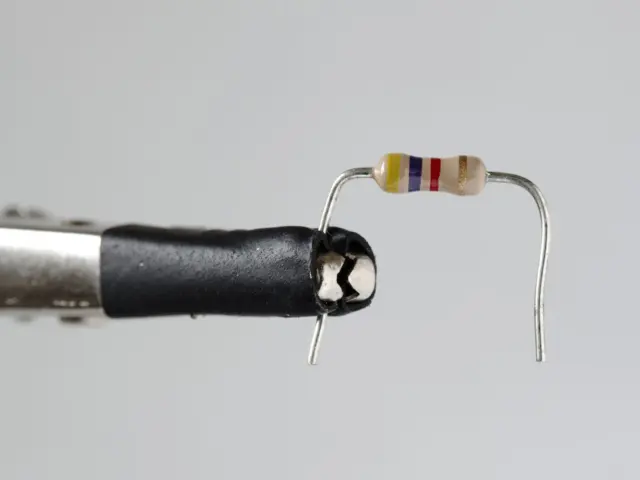
A resistor does what its name says: it resists the flow of electric current. In doing so it causes a drop in voltage and radiates heat, according to EEPower. If enough heat is generated, a resistor even glows with incandescent light.
If you want the full picture of the part, read what is a resistor for the basics. When you hold a real resistor and need to know its value, the page on the resistor color code explains how to read the bands.
EEPower lists four jobs for resistors:
- Restrict current flow.
- Develop a voltage drop.
- Generate heat.
- Generate light.
The IEEE Technology Navigator adds the physics. A resistor dissipates electrical energy as heat and obeys Ohm’s law: the voltage across it equals the product of current and resistance, measured in ohms. That linear, frequency-independent relationship makes the resistor the simplest passive element.
How resistors are built and how small they get
Inside, a resistor is a length of conductor, sometimes wound into a coil or laid into a grid so heat can escape. In electronics, EEPower notes that resistors can be as small as 1/8 watt and just 2 mm by 1.5 mm. Even smaller resistors exist in microelectronics, while larger ones can be as large as a manufacturer requires.
That range explains why a resistor on a tiny circuit board looks nothing like the heating element in a kitchen appliance. Both do the same basic thing, turning electrical energy into heat as they restrict current. The difference is how much power they are built to handle.
Types of resistor you will meet
A Patsnap Eureka explainer groups resistors into fixed, variable and special-purpose types. Fixed resistors have a constant resistance. Variable resistors, like potentiometers, allow adjustable resistance, and special-purpose parts such as thermistors and photoresistors change resistance with temperature and light.
The same explainer says resistors help set bias conditions in transistors, divide voltages and protect components from excessive current. They also appear in low-pass and high-pass filters. For the adjustable kind, what is a potentiometer shows how a rotating knob changes resistance.
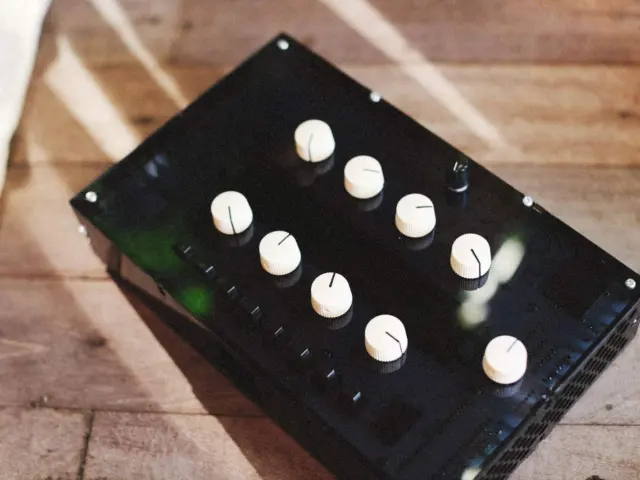
EEPower gives a familiar example of that last idea. The volume and tone settings on an amplifier are usually controlled by an adjustable rheostat or potentiometer mounted on the front panel and turned with a knob.
Resistors as heaters and in heavy industry
Resistors are the most common method of turning electricity into heat. EEPower points out that electric toasters, ovens, cooktops, space heaters, hot water systems and even bathroom heat lamps are based on resistors.
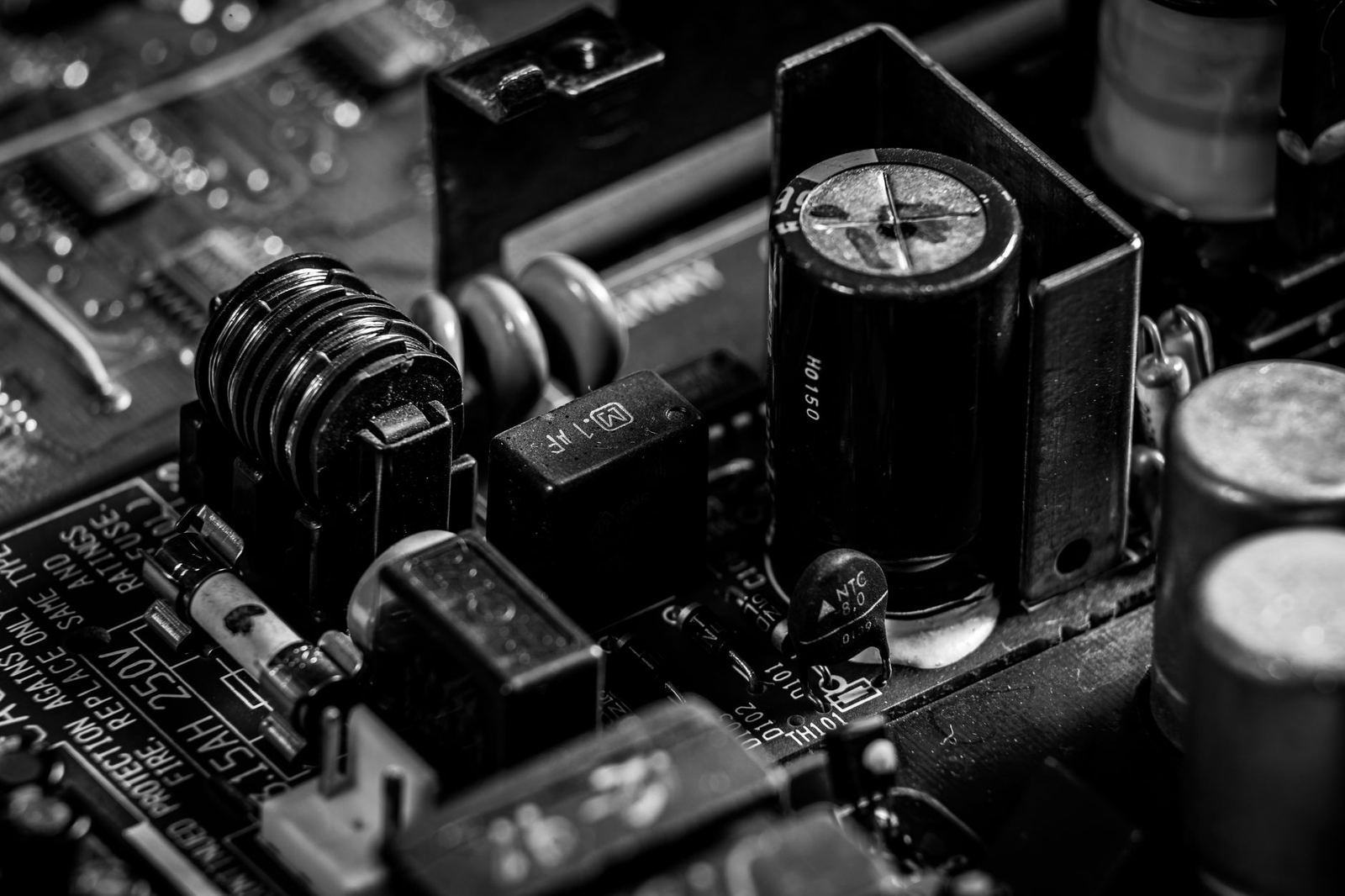
Large versions also work in industrial systems. Grounding resistors allow controlled fault currents that protect equipment, and dynamic braking resistors handle high heat and power in elevators, escalators, cranes and industrial drives. Load banks apply a dummy load to test generators, backup generation systems and uninterruptible power supplies.
Capacitors: storing energy in an electric field
A capacitor stores and releases electrical energy. In its simplest form it has two conductive plates separated by an insulating material called a dielectric, as the Patsnap Eureka explainer describes. Its ability to store charge is measured in farads.
The IEEE Technology Navigator says the energy sits in an electric field between the plates. It adds that capacitance depends on the plate area, the separation and the permittivity of the dielectric material. In words, the current through a capacitor is proportional to how quickly the voltage across it is changing.
Think of a capacitor as a small, fast tank for electrical energy. It fills when voltage rises and gives energy back when voltage falls. To see that behaviour step by step, read how do capacitors work.
Common capacitor types
Patsnap Eureka lists several families, including ceramic, electrolytic, film and supercapacitors. Each has its own character. Ceramic capacitors suit high-frequency applications, while electrolytic capacitors suit higher capacitance requirements.
Choosing between them is a real design decision, so the page on types of capacitors compares them side by side. For now, remember that the dielectric material and the construction decide where a capacitor performs best.
What capacitors do in a circuit
Patsnap Eureka describes several typical jobs:
- Smoothing out voltage fluctuations in power supplies.
- Filtering signals in audio and radio circuits.
- Timing, for example in oscillators.
- AC coupling, where the capacitor blocks DC components while letting AC signals pass.
The IEEE page also lists power supply decoupling and noise suppression networks among the uses of passive circuits. Whenever you see a small capacitor placed close to a chip on a board, it is usually doing this kind of local clean-up work.
Inductors, transformers and relays
An inductor is a component that stores energy in a magnetic field. Normally it is a wire coil, sometimes wound around a core of magnetic material, usually iron, according to EEPower. The same article notes that every conductor is also an inductor, although usually with a weak magnetic effect.
The IEEE Technology Navigator says the voltage across an inductor is proportional to the rate of change of current. Inductance is measured in henries and depends on the coil geometry and core material. For a closer look at the part itself, see what is an inductor.
Smoothing current with a choke
An inductor stores energy as a magnetic field while current increases and gives it back while current decreases. That is why it is often used to smooth the current value. EEPower calls this filtering, and an inductor doing the job is called a choke.
Inductors built for high currents typically use a single winding of insulated wire. EEPower says they are crucial in applications such as solar inverters, HVAC inverters and server power supplies, where steady current delivery matters.
From solenoids to relays
A coil on its own is called a solenoid. When a solenoid has a movable magnetic core, energizing it pulls the core into the centre of the magnetic field, which provides mechanical force. A solenoid can also attract an iron armature to operate a set of contacts, and those contacts can switch another circuit that carries a larger current.
EEPower traces the name to telegraphic communications, where such circuits were used to relay messages, so solenoid switches became relays. If you want to see how a small control signal switches a bigger load, what is a relay covers the details.
Transformers and generators
When current changes constantly, as in AC, the magnetic field keeps changing and electricity is generated in any nearby coil. EEPower calls this the transformer effect, or mutual coupling. A transformer uses it to convert electrical energy to magnetic energy and back into electrical energy in a coil with a different number of turns.
The result is a voltage suited to the job. EEPower’s example is a battery charger that can convert 230 volts from the mains supply into approximately 12 volts for a battery. Moving a conductor through a magnetic field, or a magnetic field past a conductor, also generates a voltage, which is the effect used in generators and alternators.
Active components and where diodes fit
Everything above is passive. Active components behave differently, because EEPower says they have a non-linear reaction to voltage and current. Diodes, transistors and thermionic valves are its named examples.
The IEEE Technology Navigator adds that active circuits incorporate transistors, operational amplifiers or other devices capable of providing gain. That ability to amplify is exactly what a passive network lacks. This is why a radio uses both kinds of part: passive networks pick and shape the signal, and active devices boost it.
The diode is the active part most beginners meet early, and what is a diode explains it from scratch. Diodes also show up in lighting. EEPower observes that electric lighting is undergoing a revolution, replacing incandescent lamps with arc lamps and light-emitting diodes.
Transistors, diodes and similar parts belong to the wider world of semiconductors. Our guide to semiconductor basics is the natural next step once the passive trio feels comfortable.
How components work together in real circuits
Single parts are useful, but combinations are where circuits come alive. Patsnap Eureka explains that RC circuits, built from a resistor and a capacitor, are commonly used for timing. The discharge of a capacitor through a resistor can generate precise time delays.
RLC circuits add an inductor and are integral to filters and oscillators. In filters, inductors paired with capacitors create LC circuits that can filter specific frequency ranges. Inductors also play a role in radio frequency work, such as tuning radios to the correct frequency.
Filters, matching and resonance
The IEEE Technology Navigator calls frequency-selective filtering one of the most important uses of passive circuits. Low-pass, high-pass, bandpass and band-stop filters can all be built from resistors, capacitors and inductors without any active components. Passive LC ladder filters, such as the Butterworth and Chebyshev designs, are widely used in radio frequency front ends to separate desired channels from interference.
The same page says passive networks also perform impedance matching, which ensures maximum power transfer between a source and a load when their impedances differ. In circuits with reactive parts, energy oscillates between the electric field of the capacitors and the magnetic field of the inductors. The resistors determine how quickly that oscillation dies away, and the quality factor Q describes how sharply an LC network responds to a specific frequency.
Where passive circuits show up
The IEEE page lists several everyday applications:
- Radio frequency bandpass and low-pass filters in wireless transceivers.
- Power supply decoupling and noise suppression networks.
- Impedance matching networks in antenna systems and RF power amplifiers.
- Timing and oscillator circuits for clocking and synchronization.
- Audio crossover networks in speaker systems.
- Transmission line termination in high-speed digital interconnects.
Real parts also depart from the textbook ideal. The same source warns that at higher frequencies all three passive types stray from ideal behavior, and resistors acquire parasitic inductance and capacitance. For a beginner building audio or low-speed projects this rarely matters, but it is the reason high-frequency boards need careful design.
A sensible learning order
You do not need to master everything at once. This order builds each idea on the one before it:
- Start with resistors and Ohm’s law, because voltage, current and resistance underpin everything else.
- Move to capacitors and see how they store and release energy.
- Learn inductors, then transformers and relays, which all rely on magnetic fields.
- Add diodes and transistors to meet the active side of electronics.
- Combine parts into RC, LC and RLC circuits and watch how they behave.
Once the parts are familiar, they also become easier to identify when something stops working. Our page on electronics repair shows how knowing each component’s job helps you narrow down a fault.
Frequently asked questions
What are the main types of electronic components?
Show answer
The broad split is passive and active. Passive parts such as resistors, capacitors and inductors store, release or dissipate energy but cannot amplify it, while active parts such as diodes and transistors are used in circuits that can provide gain.
Is a potentiometer the same as a resistor?
Show answer
A potentiometer is a kind of variable resistor. Patsnap Eureka describes variable resistors, like potentiometers, as parts that allow adjustable resistance, and EEPower mentions front-panel potentiometers turned with a knob to set volume or tone.
What units do resistors, capacitors and inductors use?
Show answer
Resistance is measured in ohms, capacitance in farads and inductance in henries, according to the IEEE Technology Navigator. Patsnap Eureka spells the inductor unit “henrys”, which is the same unit.
Why are capacitors and inductors often used together?
Show answer
Paired in LC circuits, they can filter specific frequency ranges. Energy moves back and forth between the capacitor’s electric field and the inductor’s magnetic field, and a resistor controls how quickly that movement fades.