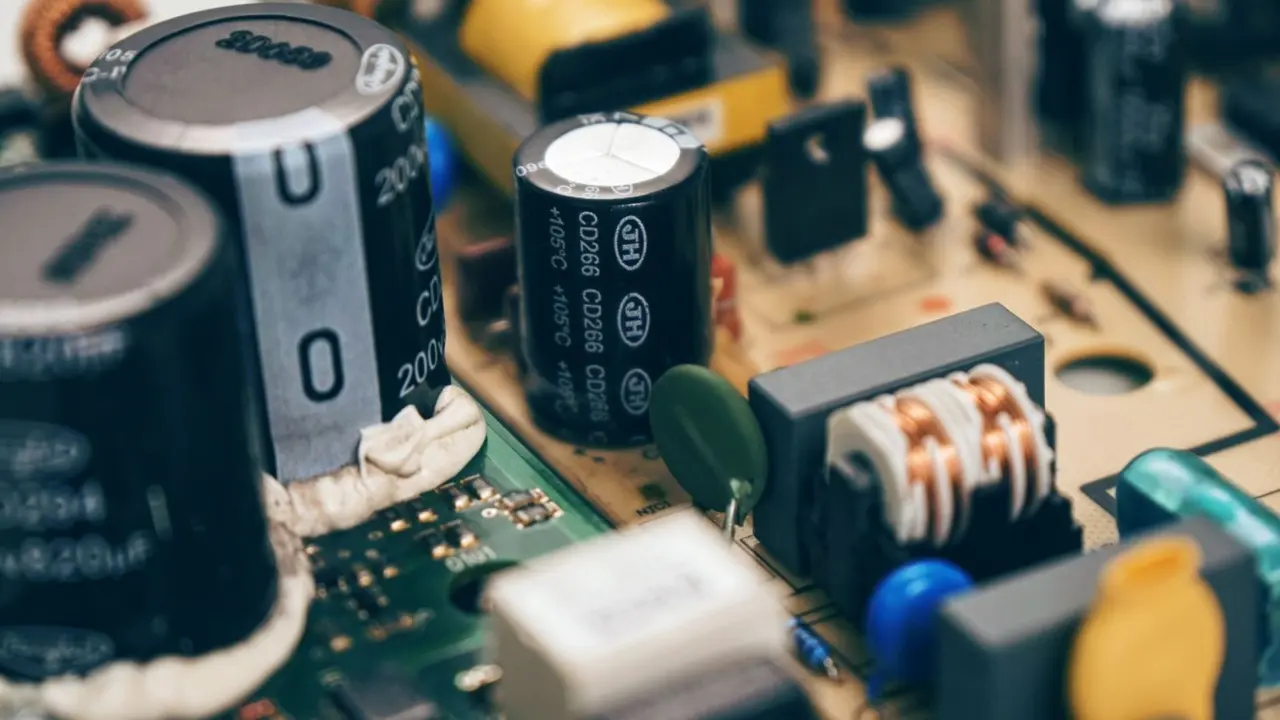
You’ve seen capacitors on circuit boards and still ask: how do capacitors work? Two plates hold opposite charges, storing energy in an electric field until the circuit asks for it back.
This page is one of the beginner guides on electronic components.
| Item | Value |
|---|---|
| Basic construction | Two metal plates separated by an insulating dielectric |
| Energy versus a same-size battery | Around 10 000 times smaller |
| Microfarad (µF) | One-millionth of a farad |
| Nanofarad (nF) | One-billionth of a farad |
| Picofarad (pF) | One-trillionth of a farad |
| Doubling the voltage | Stored energy goes up four times |
These figures come from HowToMechatronics and Albert. They can change or be revised, so check the source before you rely on them.
What a capacitor is made of
A capacitor is built from two metal plates separated by an insulating material called a dielectric, as HowToMechatronics explains. The plates are usually aluminum, tantalum or another metal. The dielectric can be paper, glass, ceramic or anything else that obstructs the flow of current.
The physical layout changes with the size of the part, but the idea stays the same: two conductors, separated by an insulator. Bristol Watch describes three common layouts:
- For very small capacitors, two circular plates sandwiching an insulating material will suffice.
- For larger values, the plates can be strips of metal foil rolled up around a flexible insulator.
- The highest capacitance values use a microscopic-thickness layer of insulating oxide between two conductive surfaces.
Capacitors sit alongside resistors and inductors as the basic passive components in electronics. If you are learning to read parts on a board, the resistor color code is a natural companion topic.
How a capacitor charges and releases energy
The working principle is easiest to follow as a short sequence. This is the version HowToMechatronics gives for a capacitor connected to a battery:
- You connect a power source. Electrons try to move from the plate on the positive lead toward the plate on the negative lead, but the dielectric stops them from crossing.
- The electrons pile up on one plate. Their repulsion grows until the source has too little energy to push in any more, and the capacitor is fully charged.
- One plate now carries a net negative charge and the other an equal net positive charge. The electric field between them holds the stored energy.
- If you remove the battery, the charge stays put. If you connect a load across the two ends, current flows through it until both plates are neutral again.
Because of this behavior, a capacitor resists changes in voltage, according to Bristol Watch. While the voltage rises, it draws current and acts like a load. While the voltage falls, it supplies current and acts like a source.
A perfect capacitor would hold its charge forever. Real ones slowly lose it through internal leakage paths between the plates, as Bristol Watch notes.
The same behavior explains how capacitors treat different signals. Brilliant states that in steady state a capacitor blocks direct current, yet it is transparent to high-frequency alternating current, which never fully charges it.
What decides how much charge a capacitor holds?
That quantity is capacitance: the charge a capacitor stores per unit of voltage. Brilliant gives the unit as the farad, where 1 F = 1 C / V.
Three physical features set the value. HowToMechatronics says capacitance grows with plate area and with the dielectric’s permittivity, and it grows as the gap between the plates shrinks.
Voltage is not on that list. Pearson points out that doubling the potential difference does not change a capacitor’s capacitance. It changes the charge and the energy, not the capacitance.
The dielectric matters because it increases capacitance by reducing the effective electric field inside the capacitor. Pearson’s table lists the dielectric constant (K), the factor by which capacitance rises when the material is inserted:
- Vacuum: 1 (exactly)
- Air: 1.00054
- Teflon: 2.0
- Paper: 3.0
- Pyrex glass: 4.8
- Water: 80
A full farad is huge for everyday electronics, so values are usually written in smaller units. Albert lists the microfarad (one-millionth of a farad), the nanofarad (one-billionth) and the picofarad (one-trillionth).
Convention can look odd at the top end. Bristol Watch mentions a large capacitor rated 330,000 microfarads, which is the same as 330 millifarads.
How much energy a capacitor stores
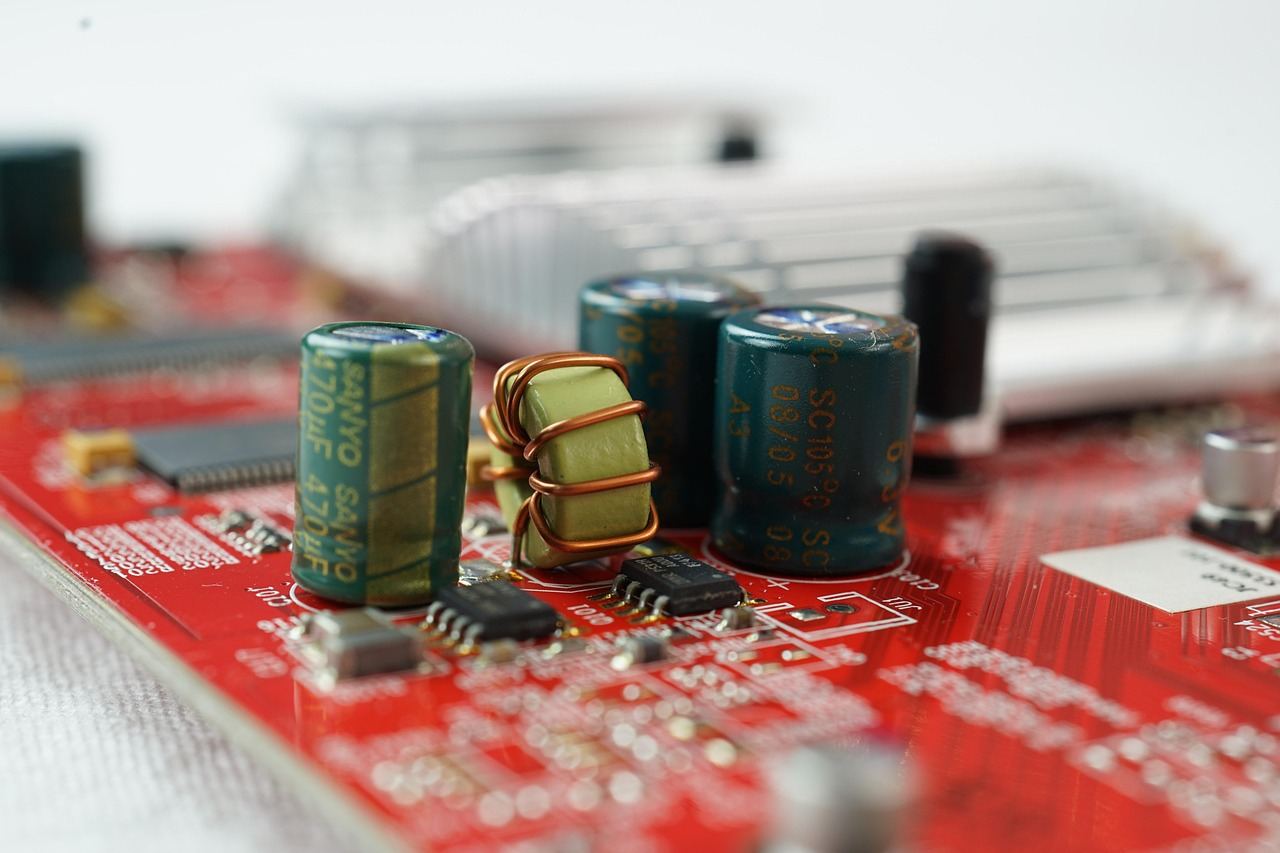
The work done in pushing charge onto the plates is what ends up stored. Pearson says that energy sits in the electric field between the plates.
Albert gives the energy as E = ½ × C × V², where C is capacitance and V is voltage. Since voltage is squared, doubling it makes the stored energy go up four times.
Here is a worked example using the setup from Pearson: a 72 pF capacitor connected to a 10 V battery. Using Q = C × V, the charge is 720 pC. Using the energy formula, the stored energy is 3.6 nJ.
That is a tiny amount, and capacitors are modest stores in general. HowToMechatronics says a capacitor holds around 10 000 times less energy than a battery of the same size. In exchange, it can deliver that energy much faster and has a better lifespan.
Charging is not perfectly efficient either. Albert notes that some energy is lost as heat when a capacitor charges and releases energy.
Where capacitors are used, and how to handle them
Most uses follow from storing a little energy and giving it back quickly. These are the common jobs described by HowToMechatronics:
- Decoupling: placed between the supply and ground of an integrated circuit, a capacitor filters noise such as voltage ripples.
- Smoothing: after a diode rectifier, the capacitor charges as the output rises and discharges as it falls, which smooths the DC output.
- Filtering: radio receivers use capacitors to tune out unwanted frequencies, and speaker crossovers use them to split low and high frequencies between woofer and tweeter.
Other examples include the flash in a camera, which needs a burst of energy, as Albert describes. Pearson adds timing devices such as windshield wipers, filters and defibrillators.
Different jobs call for different builds, from ceramic to electrolytic to film. The types of capacitors are worth comparing before you choose a part.
Handling needs care. Albert warns that a capacitor releasing its energy too quickly, such as in a short circuit, can cause harm, and it advises that you always discharge a capacitor fully before moving components.
Frequently asked questions
Do capacitors block DC or AC?
Show answer
In steady state a capacitor blocks direct current, because it charges until its voltage opposes the source. It passes high-frequency alternating current, which does not fully charge it, according to Brilliant.
Is a capacitor the same as a battery?
Show answer
No. A capacitor stores energy as an electric field between plates and holds far less than a same-size battery, but it can charge and discharge much faster and lasts longer.
Why does the dielectric matter?
Show answer
The dielectric is the insulator between the plates. It stops electrons crossing and increases capacitance by reducing the effective electric field in the capacitor.
Can a charged capacitor hurt you?
Show answer
It can, especially in high-voltage settings, if it releases its energy too quickly. Discharge it fully before you move components, as Albert advises.