You keep seeing coils in circuit diagrams and wonder what is an inductor. It is a coil of wire that stores energy in a magnetic field and resists sudden changes in current. Here is how it works in plain terms.
Inductors are one of the core parts covered in our guide to electronic components.
| Item | Value |
|---|---|
| Component type | Passive |
| Number of terminals | 2 |
| SI unit of inductance | Henry (H) |
| Typical inductance range | 1 μH to 20 H |
| Effect of a ferromagnetic core on inductance | Up to a factor of several thousand |
These figures come from Wikipedia’s Inductor article. Figures like these can change or vary by part, so check the source before you rely on them.
How does an inductor work?
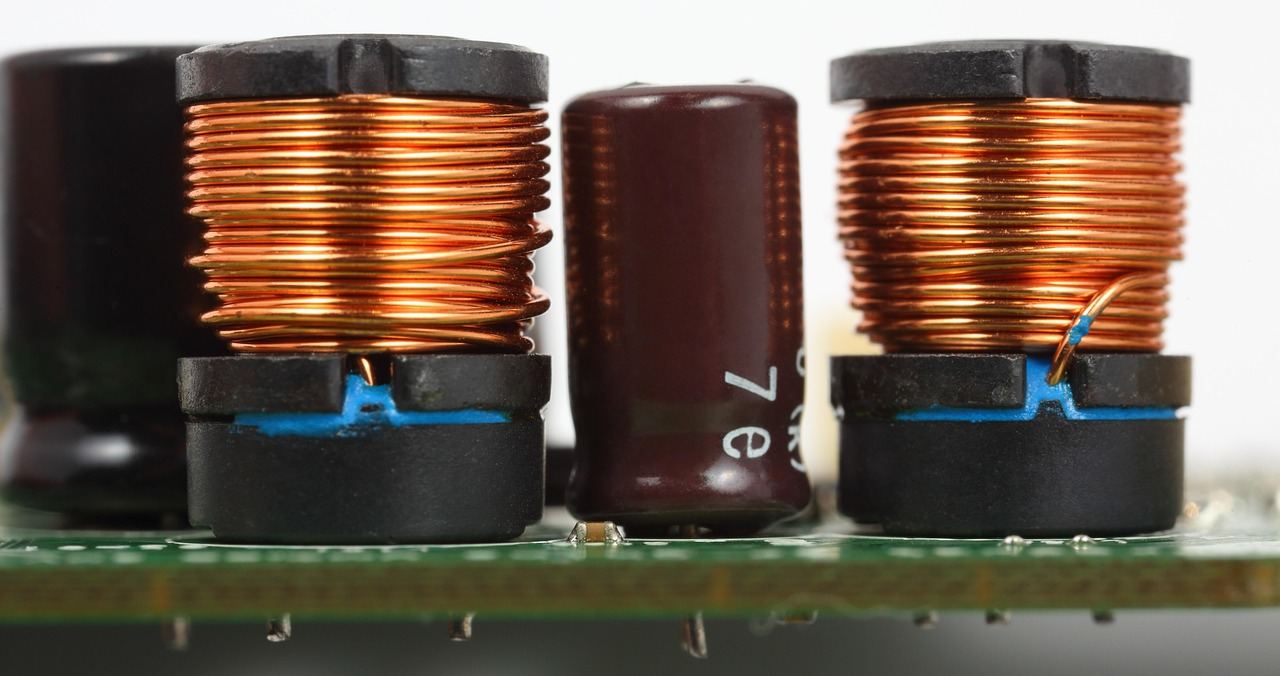
An inductor is a passive component with two terminals, usually made of insulated wire wound into a coil. When current flows through the wire, it creates a magnetic field and stores energy in it, as described in Wikipedia’s Inductor article.
The key behaviour is opposition to change. When the current changes, the magnetic field changes too, and that induces a voltage whose polarity opposes the change that created it (Lenz’s law). In practice, an inductor resists both a rising and a falling current.
The All About Circuits textbook describes three situations you can picture:
- Current rising: the inductor acts like a load, absorbing energy into its growing magnetic field.
- Current steady: the field stops changing, and the inductor behaves like a plain wire, according to PCIM’s basic-knowledge guide.
- Current falling: the field shrinks and the inductor acts like a source, releasing energy back to the circuit.
When power is first applied to an unmagnetized inductor, it initially resists current flow by dropping the full source voltage, as the All About Circuits textbook explains. As the current climbs to its maximum, the voltage across the inductor falls to a minimum.
The reason comes down to energy. The more current in the coil, the stronger the magnetic field and the more energy the inductor stores, according to the All About Circuits textbook. To store more energy the current has to rise, and to release energy the current has to fall.
Engineers have handy words for the two directions. An inductor is said to be charging while a rising current stores more energy in its magnetic field. It is said to be discharging while a falling current releases that energy to the rest of the circuit, as the All About Circuits textbook explains.
Lessons in Electric Circuits offers a memorable comparison. Just as Isaac Newton’s first law of motion describes how a mass opposes changes in velocity, an inductor opposes changes in current. In the chapter’s wording, electrons moving through an inductor tend to stay in motion, and electrons at rest in an inductor tend to stay at rest.
Because an inductor is passive, it does not generate energy of its own. It can only store and release energy that comes from other sources, as PCIM’s guide notes. The coil’s opposition to changes in its own current is known as self-induction.
Real coils also have wire resistance. In any normal inductor that resistance is enough to make a stored current decay very quickly with no external source of power, according to the All About Circuits textbook. Only superconductive wire lets an inductor sustain its current on its own.
Inductance and the henry
The measure of an inductor’s strength is its inductance, written L. The SI unit is the henry (H), and Wikipedia notes that inductors typically range from 1 μH to 20 H.
Several design choices set the value of inductance:
- Number of turns: the more turns, the higher the inductance.
- Coil shape and spacing: the shape of the coil and the separation of the turns also matter.
- Core material: a ferromagnetic core can raise inductance by a factor of several thousand over the same coil without one.
Winding wire into a coil makes the magnetic flux link the circuit many times, which boosts the field and so the inductance, as Wikipedia explains. This is why a coil stores far more energy than a straight wire carrying the same current.
Common inductor types and cores
The core is the part you will notice most when comparing inductors. Coil cores made of ferromagnetic materials such as soft iron encourage stronger magnetic flux than nonmagnetic materials such as aluminum or air, according to the All About Circuits textbook.
Wikipedia’s Inductor article groups the main types like this:
- Air-core inductors, including radio-frequency inductors.
- Ferromagnetic-core inductors, split into laminated-core, ferrite-core, powdered-iron-core and toroidal-core designs.
- Variable inductors, whose value can be adjusted.
- Chokes, built to block certain signals.
A core can be straight, or joined in a loop that is square, rectangular or circular to fully contain the magnetic flux. These design options all affect performance, as the Lessons in Electric Circuits chapter on inductors points out.
What are inductors used for?
Inductors are widely used in AC equipment, particularly radio gear. Wikipedia lists three classic jobs.
- Chokes: blocking AC while letting DC pass.
- Filters: separating signals of different frequencies.
- Tuned circuits: paired with capacitors to tune radio and TV receivers.
The name itself has a history. The term inductor seems to come from Heinrich Daniel Ruhmkorff, who called the induction coil he invented in 1851 an inductorium, per Wikipedia. Today the word choke still turns up as a common name for coils used to block signals.
Inductors compared with resistors and capacitors
Along with capacitors and resistors, inductors are one of the three passive linear circuit elements, according to Wikipedia. Each handles energy differently, and that difference is the easiest way to remember what each part does.
- Resistor: simply dissipates energy as heat, per the All About Circuits textbook.
- Capacitor: stores energy in an electric field, the dual of the inductor’s magnetic field.
- Inductor: stores energy in a magnetic field and holds its energy by maintaining a steady current through the coil.
Capacitors store their energy by maintaining a static voltage, so their behaviour is the opposite of an inductor’s. If you want to compare them side by side, read about the types of capacitors next.
Another basic part worth knowing is the semiconductor that lets current flow one way. You can learn what is a diode to round out the basics.
Frequently asked questions
Is a choke the same as an inductor?
Show answer
A choke is an inductor. Wikipedia lists choke as another name for the part, and specifically uses it for inductors designed to block AC while allowing DC to pass.
Why does a magnetic core change the inductance?
Show answer
A ferromagnetic core such as iron or ferrite increases the magnetic field inside the coil, and so the inductance. Wikipedia says this can raise inductance by a factor of several thousand.
Can an inductor keep current flowing on its own?
Show answer
In theory a short-circuited inductor would keep its current going. In practice that only happens with superconductive wire, because the resistance of the wire in a normal inductor makes current decay very quickly, according to the All About Circuits textbook.
Who discovered inductance?
Show answer
According to PCIM’s guide, Michael Faraday and Joseph Henry independently discovered inductance in the early 1830s. The SI unit, the henry, is named after Henry.