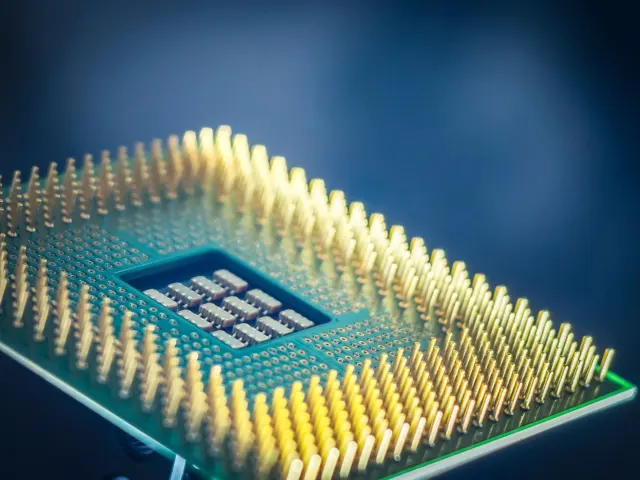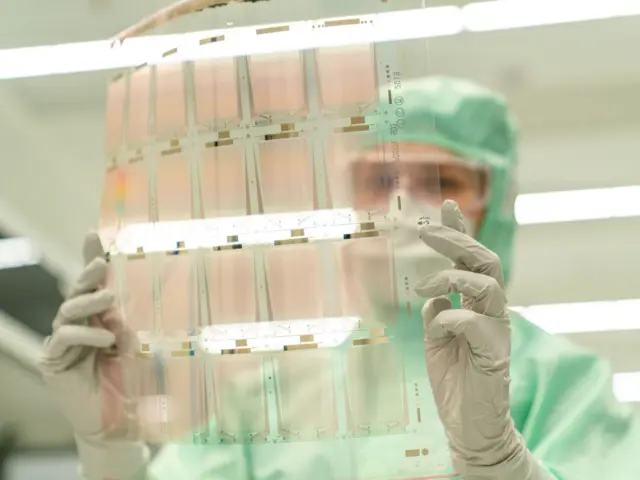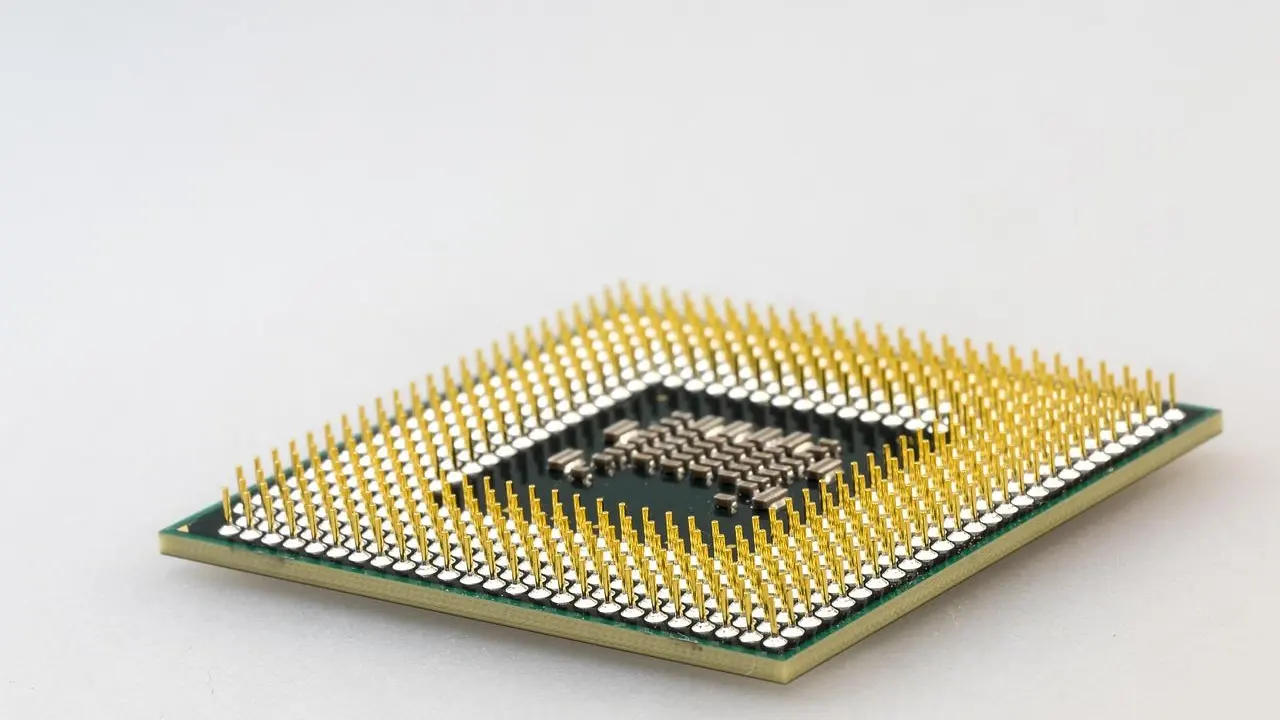
Ever wondered what is an integrated circuit and why nearly every device you own relies on one? It is a complete electronic circuit built on one thin piece of semiconductor, usually silicon, so no hand-wired parts are needed.
This page is part of the site’s semiconductor basics section, which covers the building blocks behind modern electronics.
| Item | Value |
|---|---|
| First working integrated circuit demonstrated (Kilby, Texas Instruments) | 12 September 1958 |
| First monolithic silicon integrated circuit (Noyce) | 1959 |
| Transistor count reached by the SPARC architecture | 10 billion by 2015 |
| Doubling time of components per given area | About every 2 years |
| Pin count range of integrated circuit packages | 3 to over 5,000 pins |
These figures come from IEEE Spectrum and Wikipedia’s integrated circuit entry. Sources get revised, so check the source before you rely on the figures.
What an integrated circuit is
An integrated circuit (IC), also known as a microchip or simply a chip, is a compact assembly of electronic circuits made from components such as transistors, resistors and capacitors, plus the connections between them. These parts are fabricated onto a thin, flat piece of semiconductor material, most commonly silicon, as described in Wikipedia’s integrated circuit entry.
The formal definition stresses that the elements are inseparably associated and electrically interconnected, so the circuit is treated as indivisible for the purposes of construction and commerce. In the strict sense, the term means a single-piece circuit built on one piece of silicon, which was originally called a monolithic integrated circuit. In everyday use it can also cover stacked, multi-chip, thin-film and hybrid designs.
The outside of a chip varies just as much as the inside. According to the same entry, the pin count of an integrated circuit package ranges from 3 to over 5,000 pins.
Chips perform a wide range of jobs in computers, smartphones and televisions. The same entry lists these functions:
- Data processing
- Control
- Memory and mass storage
- Power management
Where did the integrated circuit come from?
Semiconductors could take over electronics only if they shrank, and there was little progress to be made by hand soldering separate components into circuits. The solution came from two engineers working independently, and the key steps look like this:
- In July 1958, Jack Kilby of Texas Instruments came up with the monolithic idea, according to IEEE Spectrum.
- On 12 September 1958, Kilby successfully demonstrated the first working example of an integrated circuit, as Wikipedia records. It was built from germanium with gold-wire interconnects.
- In 1959, Robert Noyce invented the first monolithic integrated circuit, and his chip was made from silicon, again per Wikipedia.
- Noyce’s patent was granted in April 1961 and Kilby’s in July 1964, as IEEE Spectrum notes.
- In 1966 the two companies agreed to share their production licenses, and in 1970 the Supreme Court refused to hear the case, upholding a lower court’s ruling of Noyce’s priority, according to the same IEEE Spectrum column.
Kilby’s first design had a practical flaw: its wire connections arched above the wafer’s surface. Noyce’s patent drawing instead contained no flying wires, using metal strips deposited over the insulating oxide layer, as the IEEE Spectrum column explains.
Noyce, then the director of research at Fairchild Semiconductor Corp., favored silicon. The imec history of the microchip says he recognized that silicon would be a better material for mass production because it has superior electrical properties and is much more abundant.
Both men are credited as co-inventors. Kilby went on to share a Nobel Prize in Physics in 2000, while Noyce died in 1990, as the imec history page points out.
Why do chips beat circuits built from separate parts?
The same Wikipedia entry names three main advantages over circuits constructed from discrete components. In practice, they come down to the following:
- Size: a chip, with all its integral components, is printed as a unit by photolithography rather than being constructed one transistor at a time.
- Cost: packaged chips use much less material than discrete circuits, which keeps the price per circuit low.
- Performance: the components switch quickly and consume comparatively little power because of their small size and proximity.
Those gains made integrated circuits far smaller, faster, more energy-efficient and less expensive than assemblies of separate parts, Wikipedia says. Mass production and high reliability also helped chips replace designs built from discrete transistors.
There is a catch. The main disadvantage is the high initial cost of designing a chip and the enormous capital cost of building a factory. That is why, per the same entry, ICs are only commercially viable when high production volumes are anticipated.
How millions of parts fit on one chip
Early transistors were large components made by manually layering materials like germanium with basic techniques such as wax masking and chemical etching. Jay Lathrop revolutionized this by developing photolithography, a method that used light to precisely etch intricate patterns onto semiconductor materials, according to the imec history page.
Lathrop’s trick was flipping a microscope lens to shrink patterns, which allowed transistors to be miniaturized. Today, more advanced lithography techniques achieve nanometer-scale precision, enabling chips with billions of transistors.
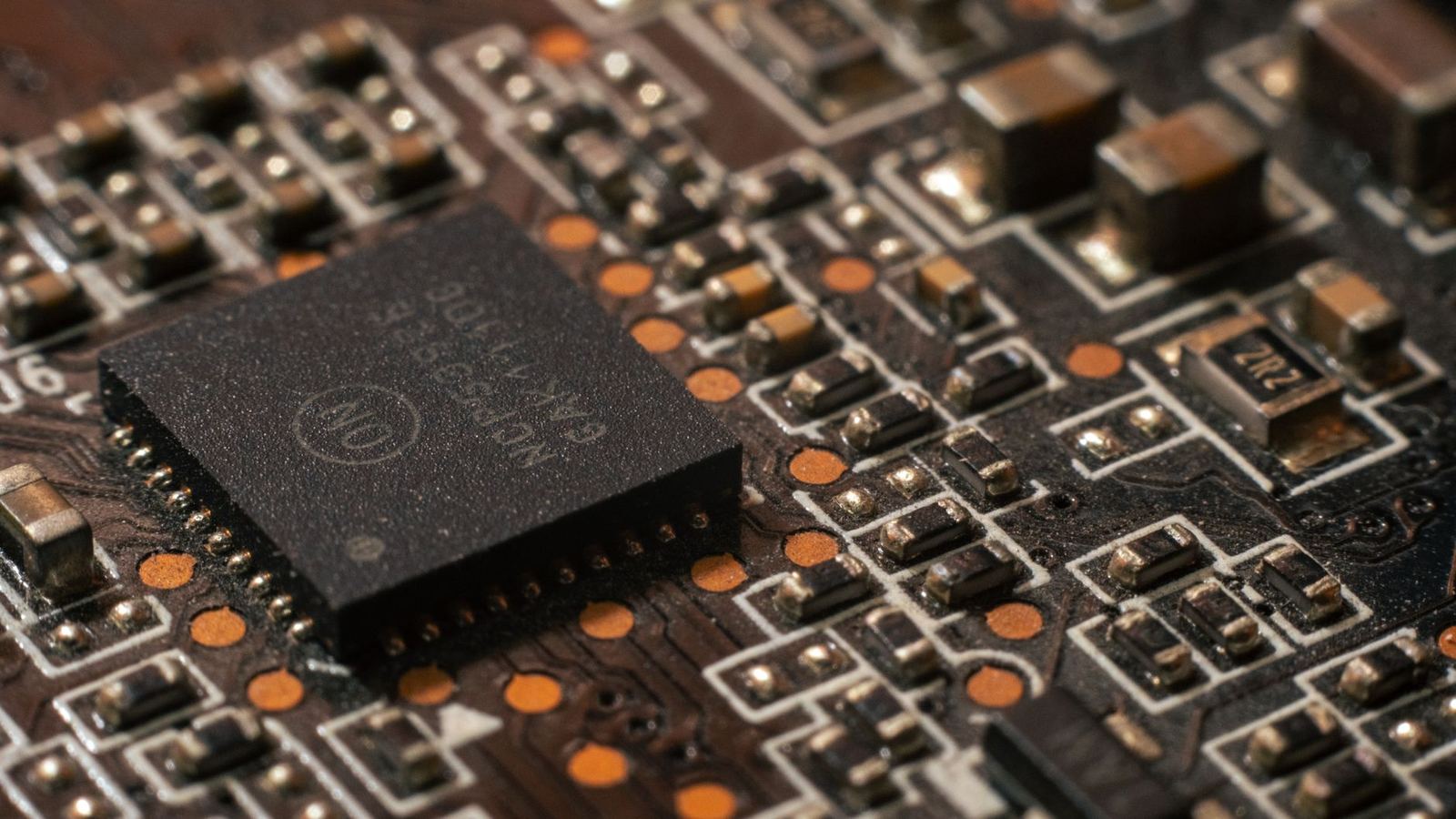
The pace of shrinking follows Moore’s law. It is named after Gordon Moore, co-founder of Intel, who observed that the number of transistors on a microchip doubled approximately every two years, as imec explains. The IEEE Spectrum column describes the number of components on a given area doubling about every two years.
The same column gives a few milestones in the climb:
- By 1971, basic integrated circuits had matured into simple microprocessors with thousands of components.
- By 2003, the component total had surpassed 100 million.
- By 2015, the SPARC architecture had reached 10 billion transistors.
That adds up to growth of eight orders of magnitude since 1965, averaging about 37 percent a year, according to the same IEEE Spectrum column. In Wikipedia’s words, a modern chip may have many billions of transistors in an area the size of a human fingernail.
Each of those transistors is a tiny switch. Readers who want to see how a single transistor switch works can start with what is a mosfet.
Where integrated circuits are used
The first chips went into military and aerospace equipment because their small size, reliability and efficiency suited demanding missions. Texas Instruments called its early designs Micrological Elements, and they were chosen to control intercontinental ballistic missiles and to help land men on the moon, as IEEE Spectrum reports. Integrated circuits were also part of the Apollo Guidance Computer, which helped navigate the Apollo spacecraft to the moon in 1969, according to imec.
Mass production then lowered costs, and chips moved into consumer products. The path to everyday devices ran roughly like this:
- By the late 1960s and early 1970s, chips were used in calculators and hearing aids.
- The Intel 4004, released in 1971, was one of the first commercially available microprocessors.
- The IBM PC, released in 1981, was one of the first mass-market computers powered by microchips.
All three steps are described in the imec history of microchips. The same page separates chips into two broad families: logic chips such as microprocessors and microcontrollers, which serve as the brains of devices, and memory chips, which store data.
Graphics processing units, or GPUs, are another type of chip. Unlike CPUs, they handle large-scale parallel data processing, which suits demanding AI tasks.
The material side of the story, meaning why semiconductors behave the way they do, is covered in the explainer on what is band gap in semiconductors.
Frequently asked questions
Is an integrated circuit the same as a microchip?
Show answer
Yes. An integrated circuit is also known as a microchip or simply a chip, according to Wikipedia’s integrated circuit entry.
Who invented the integrated circuit?
Show answer
Jack Kilby and Robert Noyce developed it independently, and both are credited as co-inventors, as the imec history page states. Kilby’s first working chip used germanium, while Noyce’s first practical version used silicon.
What is the main drawback of integrated circuits?
Show answer
The cost of getting started. Wikipedia names the high initial cost of design and the enormous capital cost of factory construction, which is why chips need high production volumes to make commercial sense.
What is Moore’s law?
Show answer
It is the observation by Intel co-founder Gordon Moore that the number of transistors on a microchip doubled approximately every two years, per imec. It has driven the semiconductor industry for decades.